Against gamification
May 24, 2026 · 4 min · teaching
This is the one essay on the site with no toy beside it, and that is deliberate. I want to set down, as plainly as I can, why the interactive figures here carry no points, no badges, no streaks, and no leaderboard — and why I think their absence is a feature I had to fight for rather than a shortcoming I failed to fix.
What gamification actually does
Gamification is the practice of wrapping a task in the machinery of games: award points for completion, grant badges for milestones, track a daily streak, rank the learners against one another. Its promise is motivation. Its mechanism is the substitution of one goal for another. The learner arrives wanting, however faintly, to understand something. The system teaches them, patiently and effectively, to want the points instead.
Sometimes this substitution is harmless, and sometimes it is even useful for drilling a rote skill that has no inner interest to protect. But mathematics is not, for the most part, a rote skill, and here the substitution does real damage. There is a well-documented effect in psychology, the overjustification effect, in which paying people for an activity they already found interesting reliably reduces their interest once the payment stops. Reward the reading of books with pizza and you get children who read for pizza and stop when full. The extrinsic reward does not add to the intrinsic one; it crowds it out.
Goodhart’s law comes to school
There is a second, colder problem. Once you decide to award points, you must decide what to award them for, and whatever you choose becomes the thing your students optimise. This is Goodhart’s law: when a measure becomes a target, it ceases to be a good measure. Award points for problems completed and you will get problems completed — quickly, carelessly, by whatever route is shortest, including the route that skips the understanding entirely. The metric climbs beautifully. The learning it was supposed to stand for quietly leaves the room.
I have watched capable fourteen-year-olds, handed a gamified maths platform, become expert not at mathematics but at the platform: farming the easy points, gaming the streak, learning precisely which button ends the session with the badge secured. They were not lazy. They were doing exactly what the system rewarded, which is what people sensibly do. The fault was in the design, which had confused engagement with education because engagement is the thing a dashboard can measure.
The other kind of reward
None of this means the figures on this site are meant to be joyless. They are meant to be rewarding, in the older sense of the word — the sense in which the reward for understanding a thing is that you now understand it. When the square wave finally assembles itself out of circles, when the pendulum’s spiral winds into its centre, when the darts settle onto π, something happens in the learner that no badge improves and every badge cheapens by association. The click of a thing making sense is the strongest reinforcement I have ever seen in a classroom, and it arrives entirely without my help. My job is mostly not to drown it out.
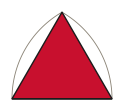
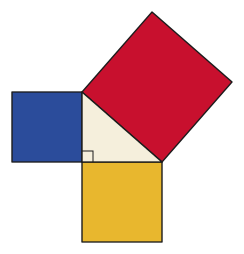
This is why the whole site borrows Oliver Byrne’s colours. Byrne did not gamify Euclid. He did something far more radical in 1847: he made the proof itself beautiful — vermilion, ochre, cobalt — so that the mathematics, not a wrapper around it, was the thing that drew your eye. The colour serves the argument. It does not bribe you to sit through it.
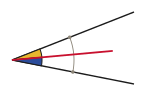
Bisect an angle, as Euclid does in his ninth proposition, and the construction is its own reward — no points are awarded, and none are needed.
I hold no grand theory that all games are bad or that competition never motivates. I hold a narrower and, I think, sturdier claim: that the reward structure you bolt onto learning will become what your students learn to pursue, and that in mathematics the thing worth pursuing is understanding, which is its own reward and is corroded by cheaper ones. So there are no points here. There is only the figure, the question it raises, and the quiet, unpurchasable satisfaction of working out why it does what it does. That is the whole offer. I have found it to be enough.