Bézier curves are just weighted averages
April 12, 2026 · 3 min · geometry, teaching
The curve that shapes every letter you are reading, every logo, every smooth path in a drawing program, is a Bézier curve — and it has a fearsome reputation it does not deserve. Behind the cubic polynomials and the control points is one humble operation your students already own completely: taking an average. The Bézier toy lets you drag the control points and, crucially, switch on the construction lines, so you can watch the averaging happen with your own eyes.
Averaging two points
Start with the smallest possible idea. Given two points, A and B, the point exactly halfway between them is their average. Slide a dial t from 0 to 1 and you can pick any point on the segment from A to B:
P(t) = (1 − t)·A + t·B
At t = 0 you are at A; at t = 1 you are at B; at t = ½ you are dead centre. Notice the two weights, (1 − t) and t, always add up to 1. That is what makes it an average rather than just a sum, and it is the entire engine of what follows. Geometers call this a weighted average; the toy calls it a construction line.
Averaging the averages
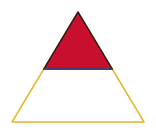
Now take three control points. Average the first pair to get a moving point A, and the second pair to get a moving point B — both sliding along their segments as t changes. Then average those two to get a single point. That final point, as t runs from 0 to 1, traces a smooth curve: the quadratic Bézier. This nested averaging is de Casteljau’s construction, and switching on the lines in the toy reveals it as a little scaffold of segments folding in on itself, each cut at the same fraction t — the same ratio that a parallel line cuts a triangle into a smaller, identical one.
Add a fourth control point and you average one more layer to get the cubic Bézier — the workhorse of every font and drawing tool. Three rounds of averaging, and the curve is drawn. There is nothing else in the box.
Why the curve stays in its cage
Drag the control points around in the toy and you will notice the curve never escapes the polygon you can draw around them — the convex hull. It always sags inside the cage of control points, never bulging out past them. Students often assume this is a rule someone imposed. It is not; it falls straight out of the averaging.

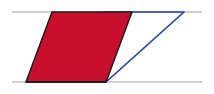
An average with non-negative weights that sum to 1 can only ever land between the things you are averaging — never outside them. A curve built entirely from such averages is therefore trapped inside the control points at every instant. This is the property that makes Béziers safe to compute with: you can bound the curve, clip it, test it for collisions, all by looking only at four corner points. The deep geometry — that averaging preserves the “between-ness” of things, the way a sheared parallelogram keeps the same base and rails — is doing quiet, load-bearing work.
I teach Béziers this way because the polynomial form, handed over cold, invites exactly the wrong feeling: that this is an arbitrary formula to be memorised and feared. The averaging form invites the right one: that you could have invented this. Give a curious fourteen-year-old two points and the idea of “somewhere between them,” and de Casteljau is only three honest steps away. The fonts came later; the averaging was always the point.