Why the Fourier drawer starts with a square wave
February 9, 2026 · 4 min · calculus, teaching
Open the Fourier drawer and the first thing it hands you is a square wave: flat on top, flat on the bottom, and a vertical cliff in between. Then it asks you to build that cliff out of nothing but sine waves — the roundest, most agreeable curves in the whole cupboard. It looks like a cruel joke. It is actually the kindest possible introduction, and I want to explain why I set it there on purpose.
A sum of turning circles
Every sine wave is the shadow of a point going round a circle at a steady speed. So a sum of sine waves is a sum of turning circles, each one riding on the tip of the last, like the hand of a clock carrying a smaller clock on its fingertip, carrying a smaller one still. The drawer shows exactly this: a little chain of circles, each spinning at its own rate, and the trembling dot at the very end traces the curve.
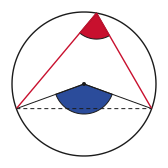
That is the whole secret of Fourier’s idea, and it is worth saying slowly. Any repeating signal, however jagged, is a chord of pure tones. The square wave is jagged in the extreme, and yet it too is only a chord. The question the drawer poses is: which tones, and how loud?
Odd harmonics, and nothing else
Here the square wave is generous. Its recipe is almost embarrassingly plain. Take the fundamental sine. Add the third harmonic at one-third the strength. Add the fifth at one-fifth. The seventh at one-seventh. The pattern is
square(x) ≈ sin x + (1/3) sin 3x + (1/5) sin 5x + (1/7) sin 7x + …
Only the odd ones, each weighted by one over itself. No cosines, no even harmonics, no mystery constants. A student can predict the next term before I write it, and predicting the next term is the moment a topic stops being something done to you.
Why the odd ones? Because the square wave has a symmetry, and symmetries in the signal become silences in the spectrum. Flip the wave left-to-right and it turns upside down; that single fact forbids the even harmonics from appearing at all. When students see that a symmetry they can point to is the reason a whole family of terms vanishes, something clicks that no amount of formula-drilling delivers.
The corner you can never quite build
Drag the slider up and the sum sharpens: the flats get flatter, the cliff gets steeper, the fit gets thrilling. And then you notice the drawer never lies to you about the catch. Right at the cliff edge, a little ear of overshoot pops up — the sum leaps about nine percent past the true value before it settles. Add more terms and the ear gets thinner, but it never gets shorter. That stubborn 9% is the Gibbs phenomenon, and it is the honest price of building a discontinuity out of continuous parts.
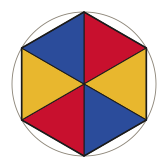
I love the overshoot because it refuses to be tidied away, like the hexagon that gets closer and closer to its circle without ever being the circle. It teaches the deepest lesson in the whole topic without a single symbol: an infinite sum can approach a shape everywhere and still disagree with it, forever, at the one point that matters most. A square wave, in other words, is where roundness and corners hold their argument out in the open.
That is why it goes first. Not because it is easy — because it is honest. It shows the machinery (turning circles), rewards prediction (odd harmonics, one over each), and then, at the cliff, admits the limit of the method to your face. Start a student somewhere gentler and you have to walk all of that back later. Start them at the square wave and the difficulty is the lesson.
When the square wave feels like an old friend, change the target in the drawer to a triangle wave and watch the coefficients fall off faster — one over n squared now, because the triangle has no cliffs, only corners. But that is the second lesson, and the second lesson has earned its place only once the first one has been seen.