What π actually measures
March 1, 2026 · 3 min · probability, geometry
Ask a class what π is and you get the ratio of a circle’s circumference to its diameter, recited like a password. It is true, and it is nearly useless, because it describes π by an act of measuring — laying a tape around a rim — that nobody in the room has ever actually done. The dart toy offers a different definition, one where π is not measured at all. It is counted.
A circle you never draw
Picture a square two units on a side, with a circle of radius one tucked exactly inside it, touching all four walls. The square’s area is 2 × 2 = 4. The circle’s area is π × 1² = π. So the circle takes up π/4 of the square — a little under four-fifths.
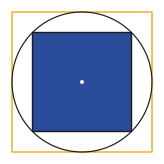
Now throw darts at the square completely at random, blindfolded, so that no spot is favoured over any other. The fraction that land inside the circle should settle, over many throws, at the fraction of the area the circle covers — that is, at π/4. Turn it around and you have a way to catch π out of the air:
π ≈ 4 × (darts inside the circle) ÷ (darts thrown)
No tape measure, no rim, no drawing. The toy never even sketches the circle — it just checks, for each random point (x, y), whether x² + y² < 1, and keeps a tally. π falls out of the counting. This is the quiet marvel I want students to feel: a fact about shape has been smuggled into a game of pure chance, and the two turn out to be the same fact wearing different coats.
The law that makes it work
Why should the fraction settle down at all? Because of the law of large numbers, which is the most reassuring theorem a nervous student can meet. It says that the average of many independent tries drifts, with near-certainty, toward the true expected value. Each dart is a tiny yes-or-no experiment; average enough of them and the noise cancels, leaving the signal — here, π/4. The running-estimate plot beside the darts is a portrait of this law doing its slow, honest work: wild at first, then calmer, homing in.
Why it is a terrible calculator
Watch the plot long enough and you notice something deflating. The estimate homes in, yes, but it crawls. Throw a hundred darts and you might get π to one decimal on a good day. Want a second decimal? You will need not ten times the darts but roughly a hundred times. The error shrinks like one over the square root of the number of throws, so every extra digit of accuracy costs a hundredfold more work.
This is why nobody computes π this way in earnest, and why I love showing it anyway. The toy is not selling you π to a million places — better methods exist, and they touch the circle directly, the way a tangent grazes it at a single honest point. What the toy sells you is the mechanism: that probability and area are the same measurement, that averaging tames randomness, and that some truths arrive quickly while others make you pay by the digit.
A child who has watched π assemble itself out of a thousand random specks, and felt the estimate stiffen with each new one, no longer thinks π is a password. They think it is a fact about how much room round things take up — which is exactly what it is, and exactly what the tape-measure definition forgot to mention.